
Views: 0 Author: Site Editor Publish Time: 2026-08-13 Origin: Site
You might wonder what products are made by roll forming today. Heavy manufacturing makes seven main metal items: structural purlins, architectural panels, solar rails, bumper beams, highway guardrails, storage racks, and window frame channels. Continuous metal rollforming shapes common metals into tough steel profiles for modern buildings.
Automated machines from leaders like RollMac make modern roll forming the best choice for builders and engineers. Advanced metal rollforming equipment shapes raw metal coils quickly and with accurate results. Reliable RollMac machinery speeds up your normal rollforming work. Smart automated controls improve rollforming output, boost rollforming accuracy, and run high-speed rollforming jobs for tough global projects.
Roll forming makes seven main metal items, such as purlins, roof panels, solar rails, bumper beams, guardrails, storage racks, and window frames.
Builders use C and Z purlins to make strong support frames for big business buildings.
Automatic roll forming machines use metal coils to make factory production faster and lower the amount of wasted material.
Cold roll forming makes steel parts stronger so safety gear can withstand hard crashes and tough outdoor weather.
Fast-working machines form metal shapes much quicker and cheaper than older aluminum extrusion methods.
People often wonder what products are made by roll forming for construction work. Large-scale metal rollforming produces vital parts for daily building projects:
Steel studs
Tracks
Channels
Custom linear profiles
You can see what products are made by roll forming by examining C and Z purlins in modern industrial plants. Large factories use these strong purlins as main support beams. Balanced C-purlins offer great strength without adding extra weight over simple spaces. Overlapping Z-purlins give even better support across connected frame joints.
Purlin Type | Design Profile Features | Mechanical Advantages |
|---|---|---|
C-Purlin | Balanced shape | Great strength with light weight and easy handling |
Z-Purlin | Offset shape with overlapping ends | Stronger support power and better frame stability |
Balanced C-purlins hold up straight weight over short spaces very well. Overlapping Z-purlins help stop sliding forces on angled roof frames. Fast purlin rollforming machines from RollMac change part sizes automatically. These smart tools also use built-in cutting blades. You can make smooth C, Z, U, and Sigma profiles with very little scrap during long factory runs.
Builders connect C and Z purlins straight into large commercial building frames. These useful metal shapes create a strong backup support network next to big main posts, roof beams, and side braces. This complete metal skeleton holds up well against tough wind storms.
Big building jobs need steady work from every rollforming machine. You get exact part sizes when using specialized RollMac cold roll forming tools. Exact metal shapes create solid joints across wide building spaces:
Weight spreading shares force evenly across outer wall panels.
Weather protection keeps secondary frames safe from heavy storms and earthquakes.
Shape holding stops roof sagging and beam bending under heavy weight.
You finish tight building schedules easily with smart automated equipment. Today's automated rollforming maintains high building quality on every commercial job site.
Choosing modern metal rollforming for roofing projects helps you create strong outer surfaces. Specialized machinery shapes flat steel coil into long roof sheets with high accuracy. Standard rollforming technology turns light aluminum into weather-proof shapes. These matching roof parts offer great weather defense in many climates. You pick fast rollforming methods for clean panel making. Quick rollforming work saves labor time when building structures.
Weatherproofing Metric | Standing Seam Panels | Corrugated Profiles |
|---|---|---|
Fastener System | Uses hidden clips that leave no hole marks, removing leak spots completely. | Uses visible screws put through the front; rubber rings wear down over time. |
Wind Uplift | Uses strong hidden clips to help roof panels survive severe storms. | Uses many visible screws, which creates weak points during powerful wind gusts. |
Rain Shedding | Offers a solid joint line that stops rainwater leaks on flat roofs. | Overlapping wave shapes let strong winds push rainwater sideways between sheets. |
Standing seam panels folded by machines work safely on low roofs with thick seal glue. Corrugated panels need a much steeper roof slope to drain water well. Strong metal sheets give standing seam panels extra toughness against heavy loads.
Hidden fastener panels shield large building walls from unwanted water leaks. Precision metal rollforming machines form these protective sheets using three main steps:
Hidden Fastener Interlocking Structure: Screws stay hidden under panel edges. This setup guards hardware from rain and stops leak holes.
Elevated Seam Connections: Locked seams sit above draining water, keeping rain out during heavy storms.
Thermal Movement Flexibility: Moving clip parts give metal room to stretch and shrink during weather changes.
You trust rollforming quality to get steady panel sizes every time. You make wall covers with smart automated rollforming tools. Continuous metal rollforming changes aluminum sheets into custom panels. Smart rollforming controls keep factory runs moving smoothly. Modern roll forming machinery boosts total shop work speed. Reliable roll forming systems offer long-lasting wall strength. Professional roll forming technology creates safe outer guards for modern building projects.
You need strong, exact channels to secure large solar panel arrays. Modern metal rollforming shapes raw steel coils into uniform mounting rails continuously. Inline punching systems pierce accurate fastener holes directly inside the active shaping line. This automated process removes secondary drilling steps and cuts labor costs dramatically. The cold working process causes work hardening, which directly elevates the overall tensile strength of your structural tubing and channel sections.
Industrial cold roll forming equipment delivers massive speed advantages over older extrusion methods. High-speed rollforming lines reach top operating speeds of up to 100 meters per minute. You maintain high precision while producing large volumes of mounting rails.
Manufacturing Process | Output Speed (Meters/Min) | Production Suitability | Cost Structure |
|---|---|---|---|
Cold Roll Forming | 10 to 60 | Preferred for large-scale, continuous manufacturing | Lower unit costs for high-volume runs |
Aluminum Extrusion | 1 to 6 | Limited by controlled cooling/shaping constraints | Higher relative unit cost for mass output |
You can deploy rollforming products across solar fields in tough outdoor environments. Utility-scale solar farms rely on galvanized steel rails to endure severe weather for decades. The outer zinc layer acts as a sacrificial anode. It corrodes preferentially to shield the base steel frame from environmental oxidation.
You protect your solar investment by using durable metal rollforming profiles. Galvanized steel channels resist harsh outdoor weather conditions better than painted aluminum alternatives.
UV Radiation Immunity: The zinc layer generates a protective zinc patina that naturally deflects UVA and UVB rays without peeling.
Broad Temperature Stability: The hot-dip galvanized coating maintains structural integrity without degrading from extreme cold (-40°F) to intense heat (392°F).
Continuous rollforming supplies heavy commercial solar installations with durable mounting hardware. Efficient rollforming machinery creates solid support channels for severe weather resilience. Dependable rollforming technology keeps your renewable energy arrays stable throughout their operational lifecycle.
Car makers use metal rollforming to shape ultra-strong steel for key safety areas. Front bumper beams must absorb big crash forces during bad head-on wrecks. Tough rollforming shapes hard steel without cracking it. This ongoing roll forming method builds complex shapes while keeping the metal equally strong throughout. You get top impact protection without making the front vehicle frame too heavy. Strong bumper rails shield important engine parts in front crashes.
Side door beams protect passengers during sudden side-impact accidents. Specialized rollforming bends flat metal strips into thin, strong channels. Advanced rollforming machines bend raw steel while cold, which raises its bending strength quite a bit. You get precise safety parts that meet strict car crash tests. Automated rollforming brings great speed and steady results for these key parts. Strong door guard beams stop dangerous cabin crushing in severe crashes. You stay safe with reliable side-impact protection.
Modern car frames use custom metal profiles to cut vehicle weight and boost total frame stiffness. Continuous rollforming turns flat metal sheets into tough roof rails, side sills, and steel tubes. Fast metal rollforming tools keep shapes exact across huge assembly runs. Auto plants swap heavy cast parts for durable roll forming profiles to raise overall gas mileage. You get lighter frame setups that handle daily road stress and shakes easily. These stiff metal parts keep car frames steady on bumpy roads.
Engineers craft complex vehicle shapes using flexible roll forming setups. Modern rollforming lines add built-in hole punching and laser welding right inside the active line. Advanced metal rollforming technology allows fast mass output with very little scrap metal. You speed up factory lines while keeping high safety levels on every car frame. Efficient production methods keep costs low while maintaining top product quality. Continuous automated shaping gives automakers a big advantage in modern manufacturing.
You see highway safety barriers whenever you drive on public roads. Specialized roll forming equipment shapes continuous metal coils into thick protective beams. High-speed metal rollforming lines bend tough steel strips into precise W-beam and Thrie-beam shapes. Continuous rollforming machines handle heavy manufacturing specifications to produce durable barriers for state highway departments.
Category | Classification | Technical Description |
|---|---|---|
Thickness Class | Class A | 12 gauge steel thickness |
Thickness Class | Class B | 10 gauge steel thickness |
Finish Type | Type 1 | Zinc coated (1.8 oz/sq. ft. / 550 g/sq. m. minimum single spot) |
Finish Type | Type 2 | Zinc coated (3.6 oz/sq. ft. / 550 g/sq. m. minimum single spot) |
Finish Type | Type 3 | Uncoated Steel |
Finish Type | Type 4 | Weathering Steel |
Manufacturing plants build these protective panels according to the AASHTO M180-79 main guardrail standard. Automated rollforming systems press precise bolt holes directly into every panel during active shaping runs. Fast rollforming speeds give you uniform structural parts across long production batches.
You rely on strong roadway barriers to contain crashing vehicles during sudden highway accidents. Modern metal rollforming shapes raw steel coils into two distinct high-performance profiles. W-beam guardrails feature two waves and deliver standard energy absorption. Thrie-beam guardrails feature three waves, larger surface area, higher moment of inertia, and superior impact resistance.
You can select high-quality base materials and coating standards for outdoor installations:
Base steel standards include Q235 (GB 700-88), equal to S235JR (DIN EN10025) and ASTM A283M.
Heavy-duty options use Q345 (GB 700-88), equal to Grade D (ASTM A283M).
Post-fabrication galvanizing follows the AS4680 standard for 2.7 BMT and 3.5 BMT guard rails.
Engineers choose precise profiles to protect drivers near steep slopes and sharp curves. Precise metal rollforming creates smooth continuous surfaces that redirect stray cars safely back onto paved lanes. Advanced rollforming equipment delivers reliable infrastructure parts that satisfy strict national crash tests.
You install strong storage shelves to keep warehouses safe. Specialized machines shape metal sheets into tall posts using metal rollforming technology. Modern rollforming machinery punches neat hole patterns along the posts during the shaping process. Strong storage racks use 3-inch or 4-inch hot-rolled structural steel channels. Workers choose metal thickness between 3/16 inch and 1/4 inch for heavy weight loads.
You select flat side beams to hold heavy pallets safely. Precision rollforming lines turn raw metal into strong hollow bars with thick outer walls. Makers select 12-gauge steel over thin 13-gauge options to boost total weight limits. High-strength metal handles massive force without bending under ASTM A653 quality rules. Fast roll forming equipment builds tough beams for everyday factory shipping work.
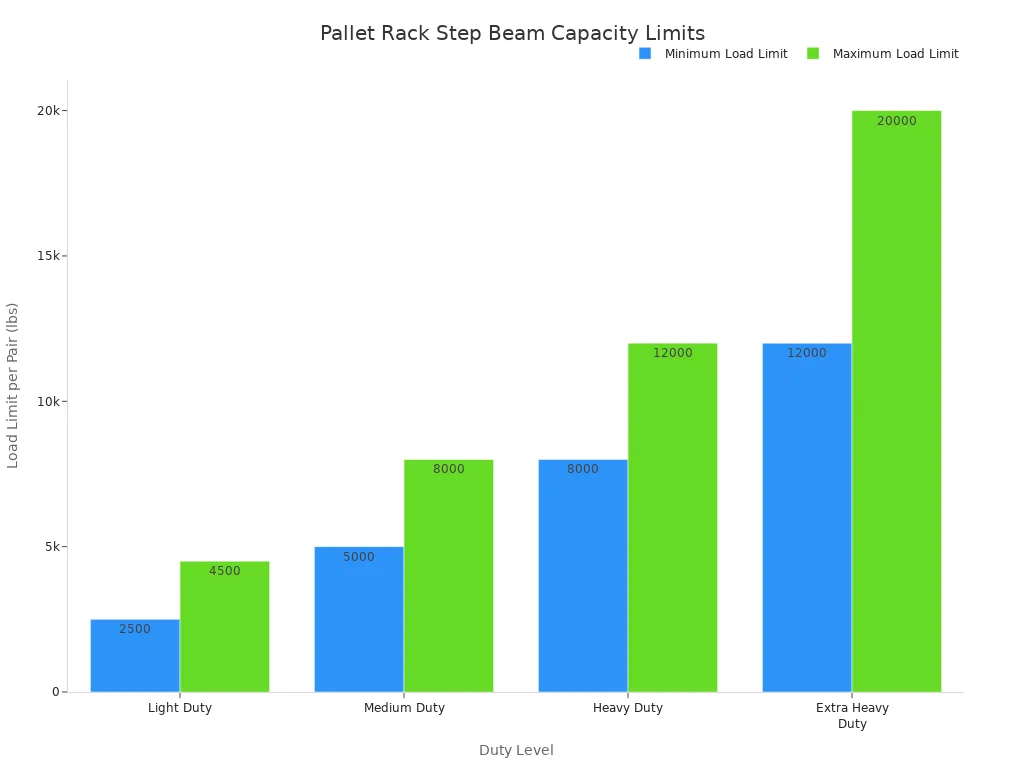
You balance weight needs across modern building floors easily. Automated metal rollforming shapes matching rack parts for fast building on site. High-speed rollforming systems bend long metal strips into straight beams quickly. Standard step beams handle four distinct weight tiers:
Duty Level | Dimensions (Step Height x Face) | Load Limit per Pair (8 ft length) | Common Applications |
|---|---|---|---|
Light Duty | 1.625" x 3" | 2,500 – 4,500 lbs | Light merchandise and boxed goods |
Medium Duty | 3.5" x 4" | 5,000 – 8,000 lbs | Standard palletized storage |
Heavy Duty | 4" x 5" | 8,000 – 12,000 lbs | Heavy industrial equipment and items |
Extra Heavy Duty | 5" x 6" | 12,000 – 20,000 lbs | Severe-duty industrial materials |
You check frame strength limits using helpful visual charts:
Smart rollforming tooling speeds up big factory work plans. Custom metal rollforming methods stop metal bending during daily storage jobs. Dedicated rollforming stations make solid frames for busy business centers. Dependable rollforming methods maintain steady product output. Continuous roll forming machinery delivers lasting strength across every busy storage room.
You can easily shape strong metal parts for modern business buildings. Cold rollforming turns flat metal sheets into smooth trim pieces and neat door frames. Specialized metal rollforming lines help you craft custom building profiles with exact measurements. RollMac equipment bends long metal coils smoothly without cracking the material.
Smart machine designs prevent weak spots during big factory jobs. You keep the metal strong even when making tricky decorative angles. Fast rollforming tools keep every edge clean, sharp, and straight. You get matching metal parts for store fronts, office doors, and heavy window frames.
You need exact shapes when making metal frames for commercial windows and doors. Modern door frame rollforming tools craft snug window channels, sturdy top headers, and protective trim. RollMac builds tough machines that meet strict safety rules and run smoothly for hours. You can shape hollow metal tubes quickly to build strong frames for large buildings.
Fast metal rollforming machines keep frame sizes exact across big factory jobs through five simple steps:
CNC Automation & Control: Smart computer systems control every step of the process to keep your work completely accurate.
High-Precision Shafting: Strong steel rollers are carefully shaped and heat-treated to keep parts aligned and prevent bending.
Post-Forming Calibration: Special leveling tools straighten metal shapes right after bending so every piece fits perfectly.
Encoder-Based Length Tracking: Built-in measuring tools guide the cutter to ensure every piece is trimmed within one millimeter.
Hardened Punching Dies: Tough steel hole punches resist wear so your hole shapes stay clean and accurate.
Smart rollforming systems give you fast, steady results you can trust. Continuous rollforming cuts down on leftover aluminum scraps during every work shift. Flexible roll forming setups let your shop switch quickly between different customer orders. Reliable roll forming machinery ensures your metal doors and windows stay strong for years.
You now see what items workers make with metal rollforming across modern building sites. Cold rollforming bends raw sheets into key items like purlins, wall panels, solar rails, bumper beams, guardrails, storage racks, and window frames. Continuous metal rollforming promises quick work speeds, exact fits, and lower material waste. Smart metal rollforming tools lower manual labor needs while keeping your daily work moving smoothly. Modern rollforming updates heavy factory work with great efficiency. Buying automated rollforming machines for your factory will boost your daily shop output right away. You can check out RollMac machinery options today to make accurate framing, roofing, and heavy building parts.
You can learn what metal goods factories build using modern roll forming methods today. Important items include strong building beams, roof sheets, solar rails, car safety bars, road guardrails, storage racks, and door frame channels. Specialized RollMac equipment crafts these long profiles without stopping.
Automated rollforming lines bend long metal coils smoothly using precise built-in cutters and hole punchers. You enter exact part sizes into computer controls before running the machine. This automated setup cuts down on leftover metal scraps and boosts your total shop work output.
Fast rollforming equipment reaches top shaping speeds from 10 to 60 meters every minute for heavy steel beams. Bending metal while cold boosts the overall strength of your steel parts during active factory runs. You reduce unit prices greatly on large orders compared to slower extrusion setups.
Shops build W-beam and Thrie-beam guardrails following strict AASHTO M180-79 safety rules for roads. High-speed rollforming lines shape thick Class A or Class B steel sheets easily. Protective zinc coatings shield these road safety barriers from harsh outdoor weather under AS4680 standards.
