Portable vs. Factory Roof Roll Forming: Which Fits the Job?
You are here: Home » News » Portable vs. Factory Roof Roll Forming: Which Fits the Job?

Portable vs. Factory Roof Roll Forming: Which Fits the Job?

Views: 0     Author: Site Editor     Publish Time: 2026-11-16      Origin: Site

Inquire

Choose portable roof roll forming when the jobsite can support safe staging, material handling, installation coordination, and inspection controls. Choose factory roof roll forming when a controlled in-plant workflow gives better control over handling, panel appearance review, and repeatable process checks; neither route eliminates appearance risks such as oil canning.

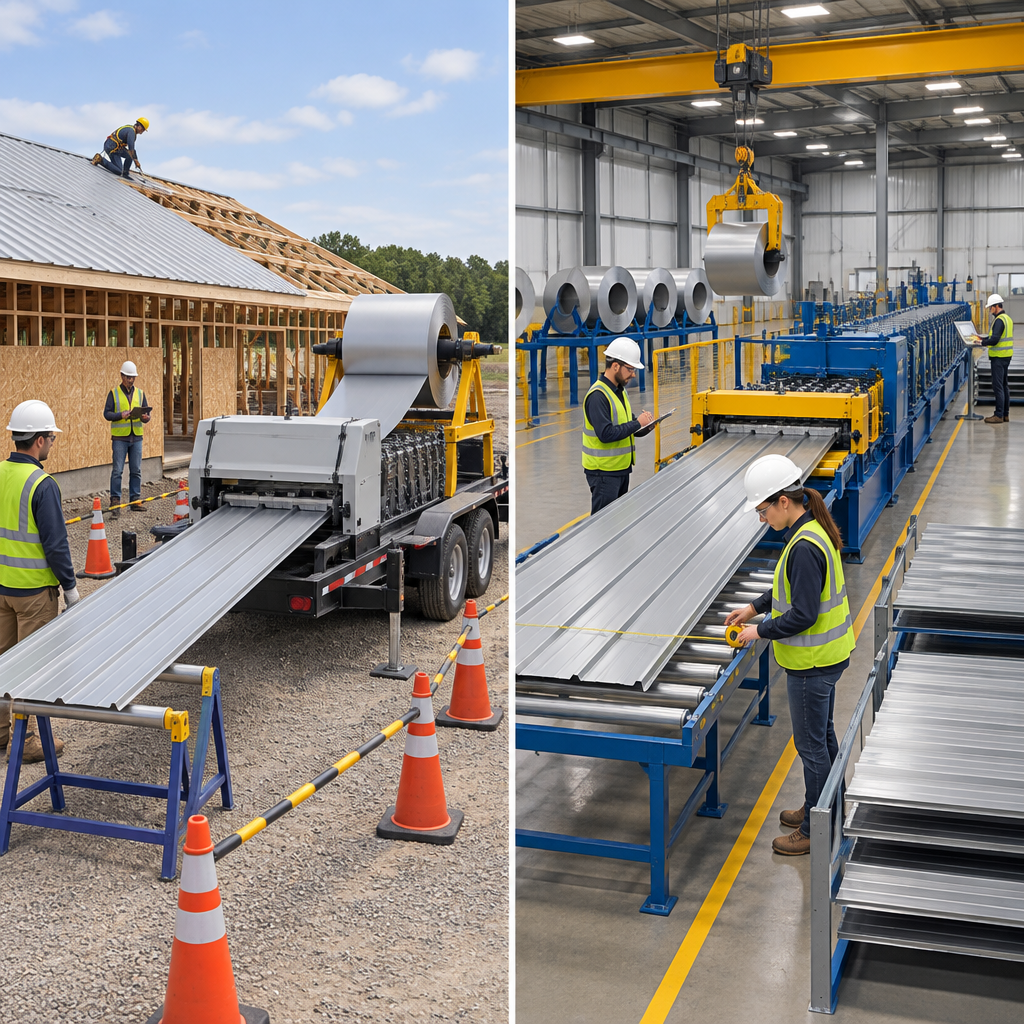
Split-view comparison of on-site portable roof panel forming and organized factory roof panel forming

Which fits the job: portable or factory roof roll forming?

The practical choice is not portable versus factory in isolation; it is whether the project can control material storage, installation sequence, accessories, inspection, and responsibility boundaries around the forming method. Appearance risk also belongs in the decision because visible waviness can occur in metal panels and cannot be completely assured away by the manufacturer, fabricator, or installer.

Portable / on-site forming

Use this path when long-panel logistics, jobsite staging, and installation timing are central to the project plan, and when the crew can protect coils, panels, sealants, fasteners, accessories, cleaning, and inspection work under site conditions.

Factory / in-plant forming

Use this path when the manufacturer wants forming, handling, storage, inspection, and dispatch to sit inside a controlled production workflow before panels move to the roof project.

Decision factor Portable roof roll forming Factory roof roll forming
Best-fit boundary Strong fit when site storage, installation timing, and inspection responsibilities can be managed near the roof work. Strong fit when plant storage, handling, inspection, and dispatch controls are the stronger part of the operation.
Quality focus Needs careful control of material selection, production practice, panel design, and installation practice to reduce appearance risk. Needs the same appearance controls; factory forming does not make oil canning impossible.
Buying question Can the jobsite protect coil, formed panels, accessories, and inspection flow? Can the plant form, inspect, store, and ship panels without creating handling or installation problems?

When portable roof roll forming fits best

Portable roof roll forming fits best when the site is ready to become part of the production system, not merely a place where a machine is parked.

Before choosing the portable route, confirm that the site plan covers coil receiving, coil protection, safe forming location, panel run-out, temporary storage, installation sequencing, final cleaning, and inspection responsibility. These are not minor logistics; the Metal Construction Association describes its Metal Roof Installation Manual as covering metal roofing materials, panel attributes, storage and installation practices, sealants, fasteners, accessories, final cleaning, inspection, specifications, and code-related responsibilities.

Portable forming is attractive when long panels would be difficult to transport, but panel length alone should not decide the purchase. The buyer should also check whether the crew can control surface handling and installation practice, because production, material selection, panel design, and installation practice all affect the tendency toward oil canning.

When factory roof roll forming fits best

Factory roof roll forming fits best when the plant can provide the more reliable environment for coil storage, process control, finished-panel handling, and inspection before delivery.

Choose factory forming when control matters most

A factory workflow is often easier to align with documented material handling, accessory coordination, panel inspection, cleaning, and release checks because these tasks can be assigned before panels leave the plant.

Do not treat the factory as a cure-all

Factory forming still needs attention to production practice, material selection, panel design, and installation practice. Visible waviness in flat panel areas can occur even when the forming route is controlled.

Factory forming becomes less attractive when transport length, unloading, temporary jobsite storage, or installation sequencing would introduce more risk than forming near the project. The buyer should compare the entire chain from coil to installed panel, not just the forming line.

Profiles, coils, software, and process checks before selection

Before selecting either method, match the required panel profile, material range, control system expectations, and process steps against the supplier’s documented machine parameters. RollMac’s website presents metal roofing machinery and a portable standing seam machine among its product lines, so buyers can use those pages as a starting point for equipment-scope questions.

Check item Ask for portable forming Ask for factory forming
Profile and dimensions Confirm that the required standing seam or roof profile, finished width, and setup approach match the documented machine range. Confirm that the in-plant line can run the same profile consistently through the planned production sequence.
Coil and material range Check compatible material thickness and coil handling limits before mobilizing to a site. Check coil storage, loading, and changeover practices against the machine’s listed material parameters.
Control and software workflow Ask how the PLC or control system supports job lengths, batch runs, and operator checks in field conditions. Ask how the control system fits the plant’s order release, labeling, inspection, and dispatch process.
Installation interface Confirm that formed panels can move directly into the installation sequence without unmanaged storage or cleaning problems. Confirm that panels can be packed, transported, received, and inspected without shifting problems to the installer.

Quality controls and appearance risks to manage

Both portable and factory roof roll forming must manage oil canning risk because visible waviness can occur in flat areas of metal roof and wall panels. Both methods also need disciplined storage, installation, cleaning, and inspection controls.

The Metal Construction Association explains in its oil canning technical resource that no panel manufacturer, fabricator, or installer can assure total prevention on any project.

That point changes the buyer’s question: instead of asking which method eliminates waviness, ask which method gives your team better control over production practice, material selection, panel design, and installation practice.

Require sample panels and visual review under agreed lighting and handling conditions before committing. A smooth sample does not guarantee every installed panel will look identical, but it helps align expectations and inspection language.

Also define who checks accessories, fasteners, sealants, final cleaning, and inspection records. These items sit outside the forming rollers but still affect the roof system handoff.

Cost drivers that change the business case

The cheaper route is project-specific because the business case depends on handling, staging, storage, installation coordination, inspection, and rework exposure rather than machine purchase price alone.

Cost driver Portable forming question Factory forming question
Mobilization and staging What site space, crew time, coil movement, and weather protection are needed? What plant space, coil staging, and finished-panel storage are needed?
Transport and handling Can forming near the roof reduce difficult panel transport without adding site damage risk? Can panels be packed, shipped, unloaded, and staged without excessive handling?
Appearance and rework exposure Can site production and installation practice minimize waviness tendency? Can plant production and later transport still preserve panel appearance?
Inspection and documentation Who records field checks before panels go onto the roof? Who records plant checks before panels are released for delivery?

A useful quotation request should therefore separate equipment cost from coil handling, tooling, setup, operator training, jobsite or plant space, inspection labor, packaging, transport, installation coordination, and expected rework allowance.

Validation checklist before committing

Commit only after the supplier’s documented machine parameters have been matched to the intended profile, coil, control workflow, and process conditions. Then test appearance and handling controls because no forming route can promise total elimination of oil canning.

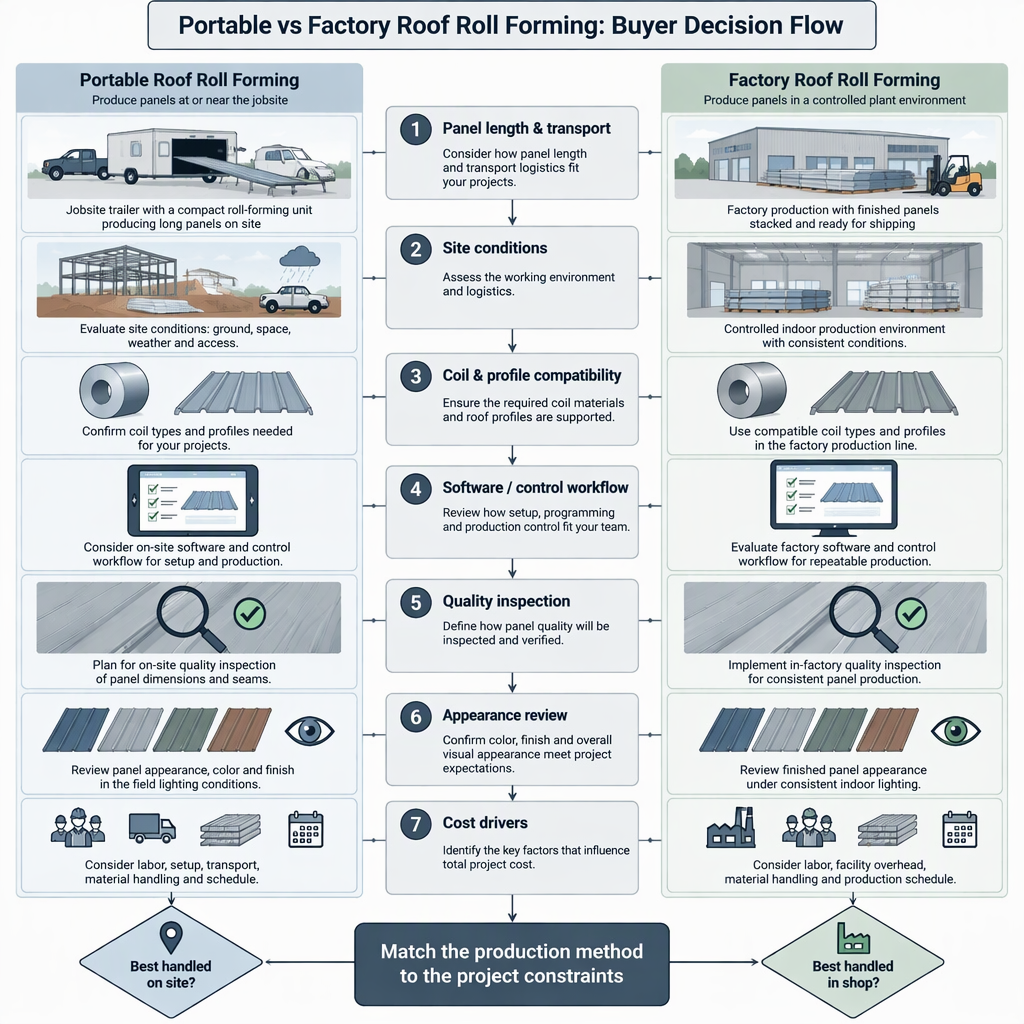
Decision-flow diagram for checking profile, coil, site, factory, quality, and cost conditions before choosing a roof roll forming method
  • Request a sample run for the target roof profile, width, and material range rather than relying on category names alone.
  • Check whether the machine control workflow supports the required job lengths, batch sequence, and operator verification steps.
  • Map coil receiving, coil protection, formed-panel movement, storage, installation, final cleaning, and inspection responsibilities.
  • Review sample panels for visible waviness and agree how appearance will be judged before project production starts.
  • Compare portable and factory routes using the same project assumptions: crew availability, staging area, handling distance, inspection points, and installation schedule.
  • Ask the supplier and installation team to document what must be measured at setup, during production, and before panel release.

How to use supplier information without overclaiming

Use RollMac’s product-category information to identify relevant roof-forming equipment families. Use the standing seam machine page to start a specification review of listed parameters, material ranges, control-system information, and related roofing-machine products.

For procurement, turn product-page parameters into a written confirmation list: profile drawing, coil specification, forming-speed range used for the quotation, control-system functions, tooling scope, cutting method, operator requirements, and acceptance checks.

A product category page is useful for narrowing the equipment conversation, but the purchase decision should still be based on the buyer’s own profile drawings, coil data, plant or jobsite conditions, and sample-run results.

Conclusion: choose by boundary conditions, then validate

Choose portable roof roll forming when field logistics and installation coordination are strong enough to support production near the job. Choose factory roof roll forming when controlled plant handling, inspection, and dispatch are the stronger route. In both cases, validate panel appearance, material handling, and installation practice because oil canning risk cannot be eliminated by choosing one forming location.

The final purchase step is a measured trial: match the machine parameters to the required profile and coil, run sample panels, inspect the result, and compare the total workflow from coil receipt to installed roof panel.

FAQs about portable vs. factory roof roll forming

These buyer questions help compare portable and factory forming with the same operating assumptions.

Can either method eliminate oil canning?

No. The Metal Construction Association states that no panel manufacturer, fabricator, or installer can assure total prevention of oil canning on any project. Treat the issue as a risk to minimize through material selection, production practice, panel design, handling, and installation practice.

Are long roof panels always better formed on site?

Not always. On-site forming can reduce some transport challenges, but it only fits when the site can control coil storage, forming space, panel movement, installation timing, cleaning, and inspection responsibilities.

Does factory forming always give better quality?

No. Factory forming may improve control over production workflow, but visible waviness can still occur in metal panels. The buyer should compare actual handling, inspection, and installation controls rather than assume a universal quality winner.

Which method is cheaper per panel?

There is no universal cost winner. Compare mobilization, coil handling, forming setup, plant or site space, packaging, transport, inspection labor, installation coordination, and likely rework exposure under the same project assumptions.

What machine specifications should be checked first?

Start with the required profile, material thickness range, finished width, roller and cutting arrangement, control-system workflow, and the supplier’s documented operating parameters for the machine being quoted.

How can RollMac information be used in this comparison?

RollMac’s website can help buyers identify relevant metal roofing machine categories and product pages. The buyer should still request project-specific confirmation for profile drawings, coils, controls, tooling scope, and acceptance checks.

What should be measured in a sample run?

Measure whether the sample matches the required profile, width, material range, length workflow, and control process. Then review handling marks and surface appearance before approving either portable or factory production.

Our machines are recognized for their stability, performance, and intelligent design, making us a trusted name in the steel structure and roll forming machinery industry.

QUICK LINKS

PRODUCTS

GET IN TOUCH
Copyright © 2025 RollMac All Rights Reserved. Sitemap|  Privacy Policy  |  闽ICP备2025111780号-1