
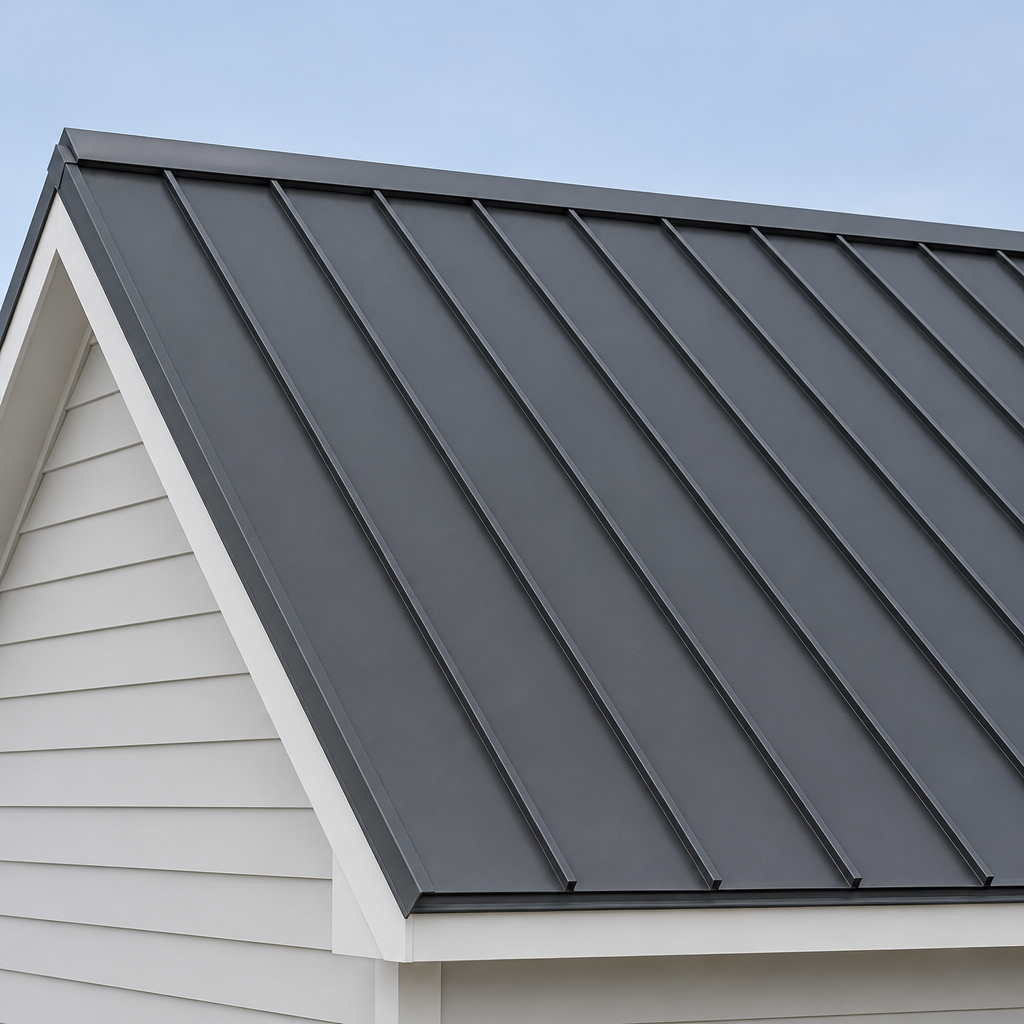
Why the Roof Profile, Not the Machine Catalogue, Starts the Selection
Selection starts with the profile drawing you intend to sell. Metal roof and wall systems come in stock sizes and finishes or can be custom-engineered for a specific project, so profile width, rib height and seam form are project decisions the machine then has to match; the American Iron and Steel Institute Build Using Steel programme describes that stock-or-custom split.
RollMac, a cold roll forming machine manufacturer based in Xiamen, states that its metal roofing machine is customised to match a customer's profile drawing.
A catalogue description does not prove a machine will form your profile to your tolerance. Send the drawing and the seam detail you are contracted to deliver, and ask for it back with the roll stations, the seam closure geometry and the tolerances the machine is designed to hold.
Coil and Material Data to Fix Before You Compare Machines
Fix the material before you compare machines. Because panels are supplied from stock sizes and finishes or custom-engineered for a project, grade range, coating system, thickness with its tolerance and the coil package are project inputs the machine builder cannot assume for you.
- Substrate and grade: the grade or grade range you will actually run.
- Coating system: metallic coating and any paint or film, since surface condition affects forming and the finished seam.
- Thickness: nominal thickness and the tolerance band you accept, from thinnest to thickest coil.
- Coil package: strip width, inner and outer diameter, and maximum coil weight.
- Profile and output: the drawing with rib height and seam type, and the output you need across a working week.
- Records: the mill and coating documents you keep with each batch, so a panel traces back to its material.
Fixed Plant Line or Portable Jobsite Machine: Which Configuration Fits the Work
Choose from where the panels must be formed. RollMac states that its portable standing seam machines form panels on site under the fabricator's control of panel length and profile; a fixed plant line forms panels at the factory.
Fixed plant line
- Panels formed: in the factory, on a stationary line.
- Panel length: set at the factory, then transported intact.
- Fits when: output is repetitive and the profile mix is stable.
- Specify: line footprint, coil handling, run-out, packing and delivery scope.
Portable jobsite machine
- Panels formed: at or beside the building, from coil.
- Panel length: formed under the fabricator's control at the point of installation.
- Fits when: buildings are remote, panels are long, or renovation work must match an existing profile.
- Specify: transport and lifting, site power, on-site coil handling, and who operates and maintains the machine.
| Decision factor | Fixed plant line | Portable jobsite machine |
|---|---|---|
| Where panels are formed | In the factory, on a stationary line | At or beside the building, from coil |
| Panel length | Limited by what can be transported and lifted as finished goods | Formed under the fabricator's control of length and profile at the point of installation |
| Profile changeover | Scheduled in the factory between runs | Handled on site; the manufacturer states its portable machines offer quick profile changeovers |
| Work pattern | Repetitive output and a stable profile mix | Remote buildings, long panels, small jobs and repair work |
| Site burden | Factory floor, power, lifting and coil storage | Space, power, lifting, coil storage and weather protection at the building |
| Main risk | Committing to a line before the profile mix is settled | Under-specifying site conditions and who will run the machine |
Adding a New Roof Profile Later: Tooling, Changeover and What to Ask
Adding a second profile is a tooling and documentation question, not just a control setting. RollMac states that its metal roofing machine is customised to match a customer's profile drawing, so ask what has to change and what the documented sequence is.
- Confirm the drawing. Send the second profile's full drawing, including seam detail, rib height and width, and ask for written confirmation that the machine can form it.
- Confirm the material. State the grade, coating and thickness band the second profile will run in.
- Ask what changes. Roll tooling, spacers, edge guides, the cut-off die and control settings are the usual candidates; ask for a line-by-line list, including how the new profile's recipe is entered, stored and reused in the control system.
- Get the procedure in writing. Request the changeover procedure as documented in the machine manual, with the time and people it needs.
- Isolate the machine before any manual access. Switch off and disconnect the machine from its power supply, and follow only the access and changeover steps the machine manual permits; never improvise the removal of guards or tooling.
- Run a sample. Form panels from your own coil and inspect seam geometry, flatness and the cut end before you accept the change.
A changeover that is possible is not the same as one you can repeat under production pressure. Ask for the tooling list, the documented sequence and a sample panel before you commit.
Forming Quality Checks That Show What the Machine Really Does
Judge the panels, not the brochure. Run a sample from your own coil and check the five points below. Seam closure matters most: the interlocking panel edge provides weather-tightness in a metal building system.
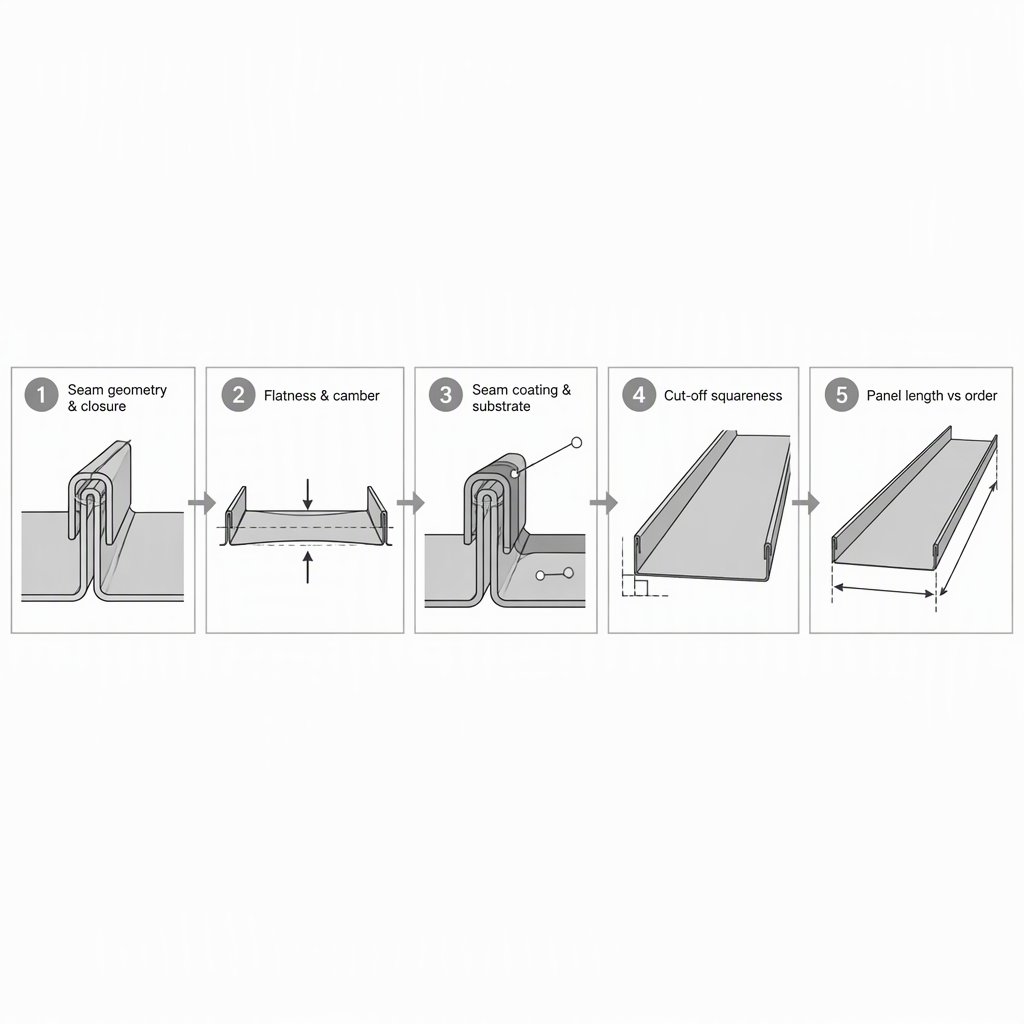
- Seam geometry and closure: measure the finished seam against the drawing, including rib height, seam width and how completely the edges interlock.
- Flatness and camber: lay panels on a flat surface and check twist, bow and edge wave along the full length.
- Coating and substrate at the seam: look for cracking, crazing, scoring or coating loss where the metal was bent hardest.
- Cut-off squareness and burr: confirm the cut end is square to the panel and leaves no sharp burr or distortion.
- Length against order: measure achieved length against ordered length, and confirm the set-up holds it across a whole coil.
Panel performance is established by testing, not by description. The Metal Building Manufacturers Association, an ANSI-accredited standards developer, maintains ANSI/SDI AISI S906-2017 (R2024) for the load-carrying strength of roof and siding panels and their anchor-to-panel attachments tested in accordance with ASTM E1592, and ANSI/SDI AISI S908-2017 (R2024) for purlins supporting a standing seam roof system. Ask for the tested panel and attachment assembly that matches your profile and keep that report with the project file; the MBMA standards list carries these titles and their edition markers, so confirm the edition in force when you specify.
Factory or Site Conditions That Change the Specification
Site and factory conditions set hard limits on the machine you can install. Available power, space for the machine and its run-out, lifting and coil handling, and, for on-site forming, working space and weather protection all shape the specification before a supplier can quote it.
Settle these early: what electrical supply can be provided, and by whom; how much clear length is available for forming and run-out; how coil arrives and who lifts it; where formed panels and offcuts are stacked; and, on site, who provides weather protection and a safe working area. Send photographs, dimensions and supply details with the enquiry, and follow the site's rules on access, working at height and electrical isolation before forming begins.
Commissioning, Training, Spares and Support: Contract the Scope, Not the Promise
Support belongs in the same document as the machine. RollMac states that it provides installation, commissioning and training services, a one-year warranty and on-site overseas maintenance support; whatever your supplier offers, scope exists only once written into the order.
- Commissioning: what the supplier performs on site, and the acceptance result that formally ends it.
- Training: how many operators and maintenance staff are trained, on which tasks, and whether profile changeover is included.
- Documentation: machine manual, electrical and hydraulic schematics, profile drawings, roll set drawings and setting sheets, in a language your team reads.
- Spare parts: a first spares list covering bearings, seals, drive components, cut-off blades, guides and roll parts, with part numbers.
- Warranty and response: what is covered and what voids it, who pays travel and parts, and the contact route for a breakdown.
Support promised in conversation is not scope; put the acceptance result, training days, spares list, warranty terms and response path into the order documents. The Metal Construction Association publishes a Metal Roof Installation Manual and operates a roofing certification programme, so where installation is contracted to a certified crew, check what that certification covers.
The Data Package to Send With a Standing Seam Machine RFQ
A comparable quotation needs the same data set from every supplier; the table below sets out what to state and why each item changes the quotation.
| Data item | What to state | Why it changes the quotation |
|---|---|---|
| Profile drawing | Full drawing with profile width, rib height and seam detail | Roll tooling is designed from the drawing. |
| Material and coating | Grade range, metallic coating, paint or film, oiled or dry coil | Roll design, surface protection and set-up follow the material. |
| Thickness range | Nominal thickness and the tolerance band you accept | Drives roll tooling, drive sizing and line stiffness. |
| Coil package | Strip width, inner and outer diameter, maximum coil weight | Sets coil handling, mandrel and line layout. |
| Panel lengths and output | The lengths you quote and the output you need per week | Determines run-out length and cut-off arrangement. |
| Configuration | Fixed plant line or portable jobsite machine, and why | Changes layout, transport, site work and support scope. |
| Site conditions | Power supply, floor or ground space, lifting and climate at the forming point | Can rule out a configuration before it is built. |
| Control system and profile data | The control system offered, how profile recipes and setting sheets are stored and revised, and how new or revised drawings are loaded | Ask whether the software and its updates are quoted with the machine or licensed separately, and who supports it. |
| Acceptance, documents and support | Sample run and checks that end commissioning, the document set, spares and support | Often the largest unstated difference between similar quotations. |
Conclusion: Select the Machine Against Your Profile and Your Site
Select the machine against your own profile drawing, coil and site: fix the material and thickness range, decide whether panels are formed in the plant or at the building, agree the checks that will end the sample run, and put documentation, spares and support scope into the order.
RollMac states that installation, commissioning, training, a one-year warranty and overseas on-site maintenance support form part of its offer; confirm each in writing for your own order.
- The profile drawing and seam detail come first; a quotation that does not return them cannot be compared.
- Fix material, thickness range and coil package before comparing roll tooling or drive sizes.
- Choose fixed or portable from where panels must be formed and how they reach the roof.
- Agree the forming checks and the acceptance run before the machine is built.
- Contract documentation, training, spares, warranty terms and the response path in the order.
- Compare quotations on one identical data set, not on headline price.
A standing seam machine performs only as well as the fit between the profile it forms, the material it is fed and the place it runs. Settle those three, and the specification, support scope and quotation comparison follow.
Frequently Asked Questions
These are the questions buyers usually raise once the profile, the material and the configuration have been settled.
Can one machine form more than one standing seam profile?
Usually, if the supplier provides the roll sets or conversion parts and a documented changeover sequence. RollMac states that its portable standing seam machines offer quick profile changeovers. Ask what changes between your profiles, and form a sample of each before accepting the machine.
What steel thickness range should the machine be specified for?
Specify the range you will actually run. Give the supplier the nominal thickness and the tolerance band you buy, thinnest to thickest, and ask for written confirmation of the working range the roll design is built for. Confirm both ends on a sample run.
Is a portable machine as accurate as a fixed line?
Accuracy comes from tooling design, frame stiffness and set-up, not from whether the machine is fixed or portable. Judge both the same way: a sample run from your coil, measured against your drawing for seam closure, flatness, camber and length, and the same measurements asked of every supplier.
What does commissioning normally include?
Commissioning should prove the machine against your profile and your material. It normally covers installation and set-up, a first run on your coil, adjustment until the formed panel meets the agreed checks, and operator and maintenance training. Define the acceptance result and the training days in the order, and confirm your supplier's services in writing.
Which standards matter for standing seam roof panels?
Standardised test methods, not marketing descriptions, establish panel performance. The Metal Building Manufacturers Association, an ANSI-accredited standards developer, maintains ANSI/SDI AISI S906-2017 (R2024) for the load-carrying strength of roof and siding panels and their anchor-to-panel attachments tested in accordance with ASTM E1592, and ANSI/SDI AISI S908-2017 (R2024) for purlins supporting a standing seam roof system. Check these titles on the MBMA standards list, ask for the test report that matches your panel and attachment, and confirm the current edition when you specify.
Do I need separate equipment for curved or corner roof panels?
Treat curved and corner work as separate equipment questions. A machine that forms straight panels may need different tooling, a curving machine or another forming route, and tapered or corner panels may be produced by trimming and folding rather than on the main line. Give the supplier the roof geometry, the radius or taper and the seam type, and ask how each element is produced.
What acceptance run should I complete before final payment?
Define it before you order. In practice it means forming panels from your own coil on the delivered machine, measuring the agreed checks against your drawing, recording the results and keeping the sample panels. Put the pass or fail criteria, the sign-off and the remedy for a failed check into the order.
How do I compare quotations from different machine builders?
Normalise the scope before comparing numbers. Ask every supplier to quote against the same profile drawing, material and thickness range, coil package, panel lengths, acceptance criteria, documentation set, spares list, control and profile-data software, and support scope, and to separate the machine from site work, commissioning and training. A lower quotation that excludes tooling, documentation, software or commissioning is not the same offer.


