
Views: 0 Author: Site Editor Publish Time: 2026-10-19 Origin: Site
Transitioning from purchasing pre-formed panels to in-house roll forming is a major capital milestone for roofing contractors and manufacturers. Relying on external suppliers means dealing with extended lead times, high freight expenses, and the constant risk of shipping damage. Bringing production in-house solves these issues. You control your schedule and build supply chain resilience. However, navigating the equipment market can be challenging. Equipment investment levels remain highly fragmented across the industry. Quotes range widely from basic imported models to commercial-grade, multi-profile setups. This variance makes it difficult to baseline a realistic budget without understanding the underlying mechanics of the machinery. To calculate an accurate long-term financial impact and ensure a profitable return, buyers must evaluate machines based on production volume, profile versatility, material capabilities, and the reliability of their roll forming machine supplier. Understanding these cost drivers is the first step toward making an informed equipment investment.
Baseline Costs Vary by Application: A portable standing seam machine offers job-site flexibility at a lower entry price, while heavy-duty in-plant machines require higher capital but deliver industrial-scale output.
Versatility Dictates Price: Single-profile machines are cost-effective but limiting; multi-profile machines with quick-change tooling command a premium but expand market reach.
Long-Term Expenses Extend Beyond the Sticker Price: Freight, setup, operator training, and preventative maintenance often account for a substantial portion of the initial first-year investment.
Margin Expansion Justifies the Cost: Bringing production in-house allows contractors to capture the manufacturing margin and eliminate third-party rolling fees.
Supplier Support is a Financial Metric: Partnering with a reputable supplier mitigates the severe financial risks of extended downtime and unavailable replacement parts.
The roll forming market segments into distinct tiers based on production capacity, mobility, and engineering tolerances. Establishing these fundamental brackets helps contractors align their operational needs with the appropriate equipment category. Entry-level machines serve basic residential needs. Mid-tier setups handle standard commercial jobs. High-volume manufacturing lines support regional panel distribution.
Mobile equipment allows contractors to spin panels directly at the project location. This eliminates the need to transport long, easily damaged panels on flatbed trucks. You simply transport raw metal coils to the site and run panels to the exact lengths required. A portable standing seam machine offers unmatched flexibility for roofing crews. However, this flexibility comes with specific trade-offs. Job-site machines face exposure to harsh weather conditions, dust, and debris. This exposure accelerates wear on moving parts. Maintenance becomes more challenging in the field compared to a controlled shop environment. Mobile units generally operate at slower run speeds to maintain stability on a trailer.
When operating a mobile unit, site preparation is critical. You must ensure the trailer sits level before running panels. Uneven ground causes the machine frame to twist slightly, which introduces camber or sweep into the finished panel. Crews must also manage coil handling in the field, often requiring a telehandler or heavy-duty forklift to load coils onto the expandable arbor.
Stationary factory-floor machines represent a larger upfront capital commitment but deliver unmatched production efficiency. These units feature heavier frames, larger drive motors, and more robust shearing mechanisms. Operating in a climate-controlled environment protects the equipment from the elements. This protection significantly extends the lifespan of rollers, bearings, and electronic controllers.
The primary benefits of an in-plant setup include substantially higher production speeds and tighter engineering tolerances. Stationary machines easily handle heavier gauge materials that would strain a mobile unit. Factory setups allow for seamless integration with automated material handling systems. Hydraulic decoilers and motorized run-out tables drastically reduce manual labor and material handling bottlenecks.
Operational Factor | Mobile Job-Site Machines | Stationary In-Plant Machines |
|---|---|---|
Production Speed | Moderate (optimized for trailer stability) | High (optimized for volume output) |
Material Handling | Requires field equipment (telehandlers) | Utilizes overhead cranes or shop forklifts |
Environmental Exposure | High (rain, dust, temperature swings) | Low (climate-controlled facility) |
Panel Length Limits | Virtually unlimited (run directly onto roof) | Limited by truck and trailer transport capacity |
Beyond the basic category of the machine, internal engineering and technical specifications drive the final purchase price. Buyers must carefully match the machine's capabilities to their target market. Overspending on unnecessary features ties up capital. Under-equipping your crews leads to lost bids and operational frustration.
The number of panel profiles a machine can produce directly impacts its complexity. Fixed-tooling machines are dedicated to a single profile, such as a standard mechanical seam. Because the rollers are permanently set in place, the manufacturing cost of the machine remains relatively low. These units are highly reliable and require minimal adjustment. They restrict your business to one specific panel type.
Multi-profile machines offer the ability to switch between different panel styles. You might run snap-lock for residential jobs, mechanical seam for low-slope commercial roofs, and nail-strip for specific architectural designs. This versatility requires adjustable tooling or quick-change cassette systems. Engineering a machine to swap profiles accurately without losing tolerance requires precision machining and complex frame designs. This capability commands a premium price. The investment expands your market reach, allowing you to bid on a wider variety of architectural and commercial projects.
When changing profiles on a cassette-style machine, operators follow a strict sequence:
Lock out the machine power to ensure operator safety.
Disconnect the drive coupling from the active cassette.
Use an overhead crane or forklift to lift the current cassette out of the chassis.
Lower the new profile cassette into the alignment pins.
Reconnect the drive coupling and verify roller clearances before running test panels.
A machine's ability to form tough materials heavily influences its internal construction. Pushing 22-gauge steel, copper, or zinc through a series of forming dies requires immense torque and rigid structural support. To prevent scratching painted aluminum or copper, manufacturers often utilize polyurethane rollers. These specialized rollers add to the component costs but are mandatory for high-end architectural work.
The drive system itself is a major cost driver. Entry-level machines may use standard chain drives. These are cost-effective but can develop slop over time, leading to panel variations. Premium machines utilize heavy-duty gear-driven systems that maintain absolute precision over thousands of hours of operation.
Buyers must choose between hydraulic and electric drive systems. Hydraulic systems offer incredible raw power and durability for heavy-gauge materials. Electric drives often provide cleaner operation and simpler maintenance for standard architectural panels. A robust standing seam machine relies on its drive system to maintain consistent panel lengths and seam dimensions.
The level of automation dictates both the speed of production and the required skill level of the operator. Manual measurement and cutting systems keep equipment costs low but increase the risk of human error and material waste. Fully automated Programmable Logic Controller (PLC) systems represent a significant step up in technology.
With a PLC, operators program exact batch quantities and panel lengths. The controller automatically advances the metal, actuates the shear, and stops the machine when the batch is complete. Advanced batch-control software minimizes material waste during high-volume runs. It ensures every panel matches the exact specifications of the roof plan. This technology requires a larger upfront investment but pays dividends in reduced scrap and lower labor costs.
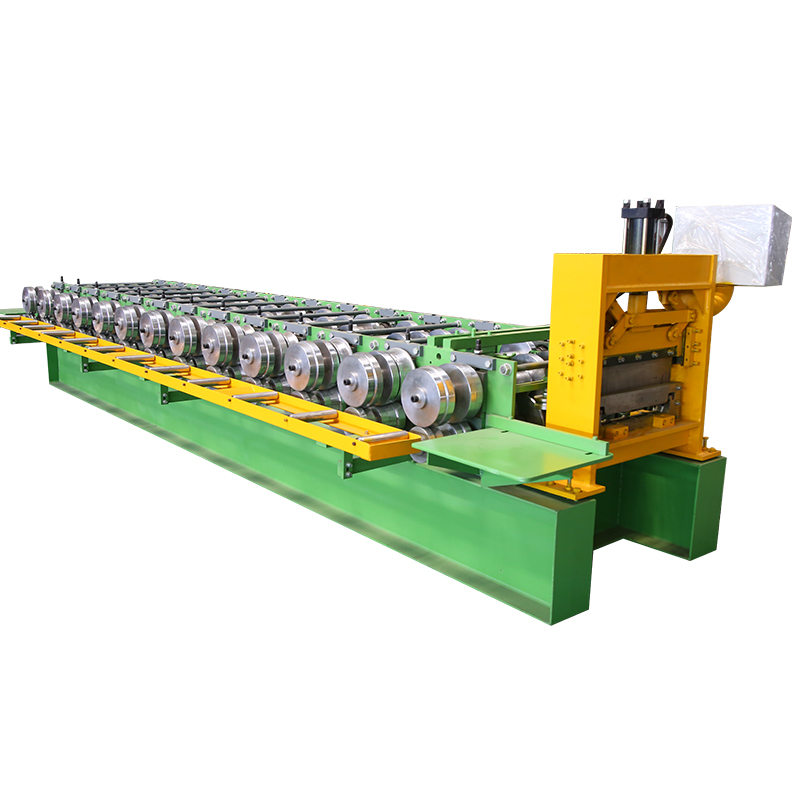
A standard roll former produces straight panels. Complex architectural projects often require secondary equipment and material handling accessories to complete the production line.
Architectural roofs featuring barrel vaults, domed structures, or curved transitions require specialized machinery. Standard roll formers cannot bend a finished panel along its length without buckling the seams. To achieve this, contractors must invest in a standing seam curving machine.
The pricing variables for curving equipment depend on the method used. Crimp-curving machines place small indentations along the panel to force a radius. These are generally more affordable but leave visible marks on the metal. Smooth-curving machines use specialized, highly polished rollers to stretch the metal into a radius without marring the finish. Smooth curving requires tighter engineering tolerances and represents a higher capital investment. It is often mandated for high-end architectural copper and painted steel projects.
The roll former is only the center point of the production line. Feeding raw material into the machine safely and efficiently requires a decoiler. Manual expandable-arbor decoilers serve as the entry-level option. Operators manually load and brake the coil. High-volume operations require heavy-duty automated hydraulic decoilers. These units handle massive coil weights, feature motorized uncoiling to match the speed of the roll former, and include hydraulic expansion for rapid coil changeovers.
Once the panel exits the shear, it must be supported to prevent bowing or scratching. Run-out tables are essential for safe material handling. Basic gravity-roller tables are cost-effective. Automated stacking systems gently drop finished panels into shipping crates. This automation significantly increases production speed and reduces the labor required at the exit end of the metal roofing machine.
Evaluating an equipment purchase based solely on the sticker quote is a dangerous financial oversight. The true lifetime expense of the machinery includes logistics, setup, and ongoing operational requirements.
Moving heavy industrial machinery requires specialized transport. Buyers must account for flatbed freight costs and rigging services to unload and position the machine. Facility modifications may be necessary to accommodate the equipment's footprint and power requirements. If importing a machine from overseas, buyers must factor in customs brokerage fees, port handling charges, and unpredictable tariffs that inflate the final landed cost.
Every new piece of equipment comes with a learning curve. You must factor in the labor hours required for factory commissioning and operator training. Running a roll former requires technical skill. Adjusting tension stands to eliminate camber (lateral curve) and sweep (vertical curve) requires experienced hands.
When feeding a new coil, the operator must jog the material slowly through the entry guides. You check the alignment at the first forming station to ensure the metal isn't walking to one side. If the panel exits the shear with a downward bow, you adjust the exit straightening block upward to compensate. Dialing in these adjustments takes patience and a deep understanding of how different metal alloys react to the forming dies.
During this initial calibration phase, operators inevitably generate scrap metal. Budgeting for this initial material waste is a necessary part of the setup process. A proper setup sequence includes:
Verifying the incoming power supply matches the machine's requirements.
Leveling the machine frame using precision machinist levels.
Squaring the entry guide assembly to ensure the coil feeds perfectly straight.
Running short test panels to check seam dimensions with digital calipers.
Adjusting the shear blade clearance based on the specific material gauge being run.
Continuous production requires continuous maintenance. Operators must grease the main drive bearings weekly. You should inspect the polyurethane drive rollers for metal shavings that could embed in the surface and scratch painted coil. The hydraulic power unit requires fluid level checks before every shift, and the return filters need swapping every 500 operating hours. Keeping a detailed maintenance log prevents catastrophic failures during peak roofing season.
The shear blades, typically made of D2 tool steel, eventually dull. Cutting heavy 22-gauge steel accelerates this wear. Blades require professional sharpening or replacement. Rollers must be periodically recalibrated to ensure the panel seams lock together correctly on the roof. Ignoring these ongoing consumable costs leads to poor panel quality and eventual machine failure.
The company standing behind the equipment is just as important as the steel frame itself. The cheapest machine on the market quickly becomes a financial liability if you cannot get it running when a critical project deadline approaches.
Importing equipment often presents an attractive upfront cost savings. This route carries substantial long-term risks. Language barriers complicate technical troubleshooting. Time zone differences mean waiting 24 hours for a simple email reply. Imported machines may use proprietary electronic components or electrical standards that are difficult to source or repair locally. Domestic sourcing, or buying from an importer with a strong local presence, ensures help is available during your normal operating hours.
A higher initial purchase price from a reputable supplier often includes comprehensive warranties and dedicated technical support. When a sensor fails in the middle of a commercial run, waiting two weeks for a replacement part from overseas is not an option. Reputable suppliers maintain extensive local parts inventories and offer overnight shipping. This level of support drastically reduces downtime, ultimately lowering the overall lifetime expense of the machine.
Acquiring heavy machinery does not always require draining your operating capital. Many suppliers work with industrial lenders to offer equipment financing or leasing options. Structuring the purchase through financing allows the machine to generate revenue while you pay for it. Leveraging tax codes like Section 179 deductions allows businesses to write off the entire purchase price of qualifying equipment in the year it is placed into service. This makes higher-tier machines significantly more accessible for growing contractors.
The decision to invest in a standing seam roof panel machine hinges on a clear return on investment calculation. You must determine exactly when the equipment will pay for itself and begin generating pure profit.
When you purchase pre-formed panels, you pay for the raw metal, the supplier's labor, the crating materials, the freight, and the supplier's profit margin. Owning the equipment shifts that manufacturing profit margin directly to your bottom line. You purchase raw coils at wholesale rates and convert them into finished roofing products. This margin expansion is the primary financial driver for bringing production in-house.
To justify the investment, contractors must calculate their break-even point. Audit your historical data to determine how many linear feet of standing seam roofing you install annually. Compare the total cost of buying those panels from a supplier against the cost of raw coil plus the monthly financing payment for the machine. Once your annual volume crosses this threshold, owning the equipment becomes mathematically superior to outsourcing.
Many contractors rely on third-party chop-and-drop services. A separate company brings a machine to the site and runs the panels for a per-foot fee. While this avoids capital expenditure, it eats heavily into project profitability. Operating your own equipment replaces these variable third-party fees with a fixed, predictable operating cost. It puts you in complete control of the production schedule, rather than waiting for a subcontractor to become available.
Producing panels on-site or in your own facility eliminates the need for expensive wooden crating. It completely removes the risk of freight damage. Forklift forks piercing a crate and ruining hundreds of feet of finished panels is a common industry headache. Buying raw coil allows you to stockpile material. This stabilizes your pricing against sudden market fluctuations and supplier markups.
The cheapest equipment option is rarely the most cost-effective solution when you factor in the realities of production downtime, material waste, and limited profile capabilities. A successful equipment purchase requires looking past the initial quote and analyzing the long-term operational impact on your business. Before requesting quotes, take the time to audit your specific needs. Calculate your annual linear footage requirements, identify the specific panel profiles your local market demands, and assess the physical space available in your facility or on your trailers.
To move forward with confidence, follow these actionable steps:
Document your required material gauges, preferred profiles, and expected daily production volume.
Assess your facility's power capabilities or determine the generator requirements for a mobile setup.
Evaluate your local market to see if adding specialized capabilities will open new bidding opportunities.
Contact a vetted, reputable supplier to request a customized production analysis and discuss local parts availability.
A: The required capital depends heavily on the machine's capabilities. Basic single-profile units represent a lower entry point. Advanced multi-profile machines with automated PLC controllers and gas-powered engines require a premium investment. Features like quick-change tooling and heavy-gauge forming capabilities naturally increase the initial expenditure.
A: With rigorous preventative maintenance, high-quality machines easily last fifteen to twenty years in active service. The heavy steel frames and forming rollers are highly durable. Electronic components, such as PLC controllers and touchscreens, may require upgrading or replacement as technology advances during that lifespan.
A: Yes, multi-profile machines are designed specifically for this purpose. They utilize adjustable tooling or interchangeable cassette systems to switch between profiles like snap-lock, mechanical seam, and nail-strip. While they require a higher initial investment, they provide unmatched flexibility to bid on diverse architectural projects.
A: Owning the equipment allows you to purchase raw metal coils directly. You bypass the supplier's markup on finished panels, crating, and shipping. By capturing the manufacturing margin and eliminating third-party on-site rolling fees, contractors significantly increase their net profit per square foot of installed roofing.
A: This depends entirely on your annual volume. Low-volume contractors often save money by purchasing pre-formed panels, avoiding the capital expense of machinery. High-volume businesses save significantly by roll forming in-house due to eliminated freight damage, stabilized raw material pricing, and the removal of supplier markups.
A: Prioritize suppliers that offer robust domestic support, readily available spare parts, and comprehensive operator training programs. Transparent warranty terms and accessible technical support are critical to minimizing downtime when mechanical or electronic issues arise during a tight project schedule.
A: Yes. Standard roll formers are engineered to produce straight panels. If a project requires arched panels for barrel vaults or domed roofs, you must use a specialized curving machine. This secondary equipment stretches or crimps the finished panel to the exact radius required by the architectural plans.


