
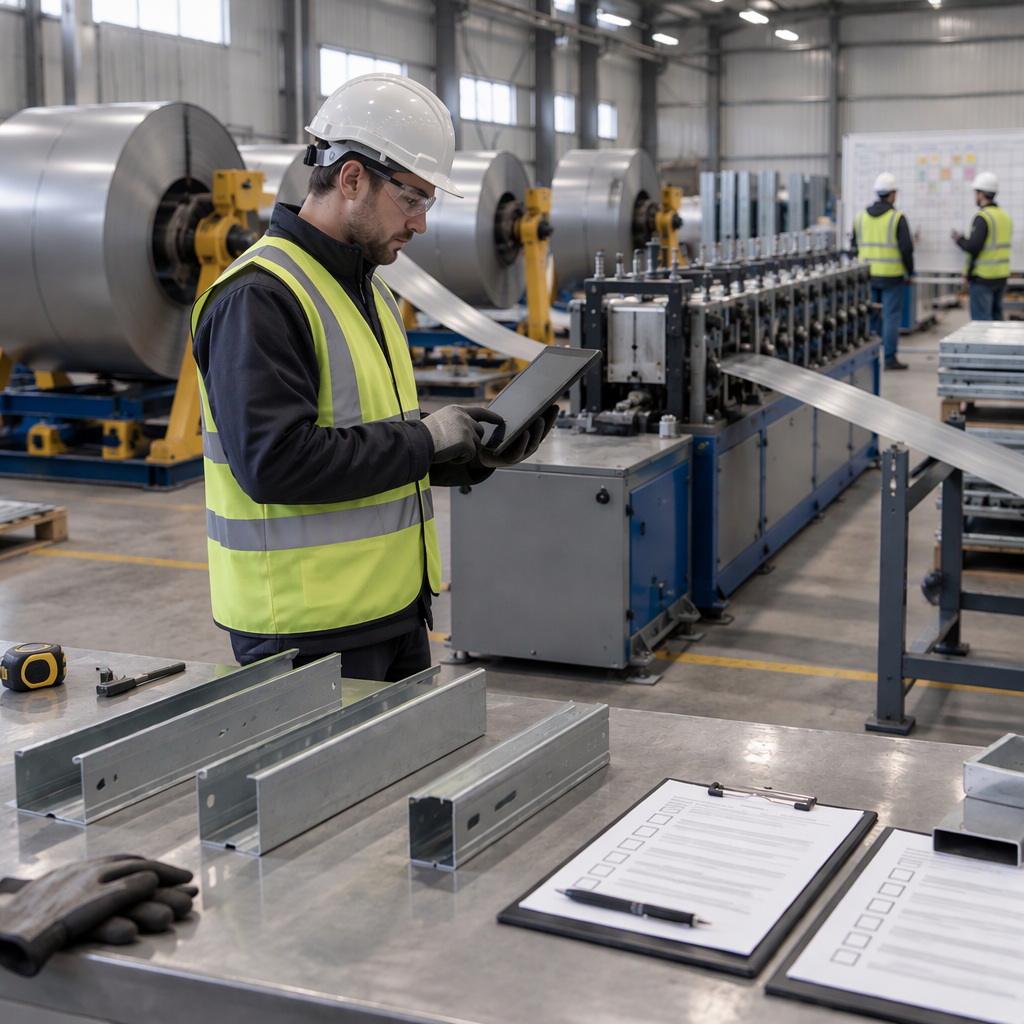
Why Rated Line Speed Is Not the Same as Output
Rated line speed describes ideal movement through the line; practical output depends on how much planned time becomes run time, how closely the line performs to its ideal rate, and how many finished members pass quality checks.
A line can appear fast on a brochure and still produce fewer good pieces per shift if jobs require frequent punching, short parts, coil changes, software corrections, manual handling, inspection holds, or rework. Treat headline speed as a starting assumption, not as the production estimate.
For selection, ask what operating conditions the rated speed assumes. A useful estimate should state the product mix, coil condition, member length range, punching and cutting pattern, shift time, planned stops, acceptance criteria and downstream constraints.
Collect the Inputs That Actually Control Capacity
Before calculating output, collect the inputs that change planned production time, run time, ideal cycle time, total count and good count.
- Shift and planned production time: record the available production window after planned breaks, meetings, maintenance windows and scheduled changeovers are removed.
- Run time assumptions: estimate how much of the planned time the line will actually run after coil loading, setup checks, job-file loading and routine stoppages.
- Ideal rate basis: define whether the ideal rate is stated as meters per minute, pieces per hour, or ideal cycle time per member.
- Product mix: separate wall studs, tracks, joists, roof members or other profiles if they differ in length, gauge, hole pattern, notch pattern or cut frequency.
- Coil and profile conditions: record steel grade, thickness range, coil width, coil weight, lubrication needs and profile tolerance expectations that affect forming stability.
- Job data and software workflow: include file import, nesting, labeling, print or mark data, and operator checks before the line starts.
- Quality definition: define good count as members that meet the buyer’s dimensional, hole-position, cut-length, surface and labeling acceptance checks.
Build a Simple Output Calculation Model
A practical model converts rated speed into expected good output by applying availability, performance and quality to the planned production time.
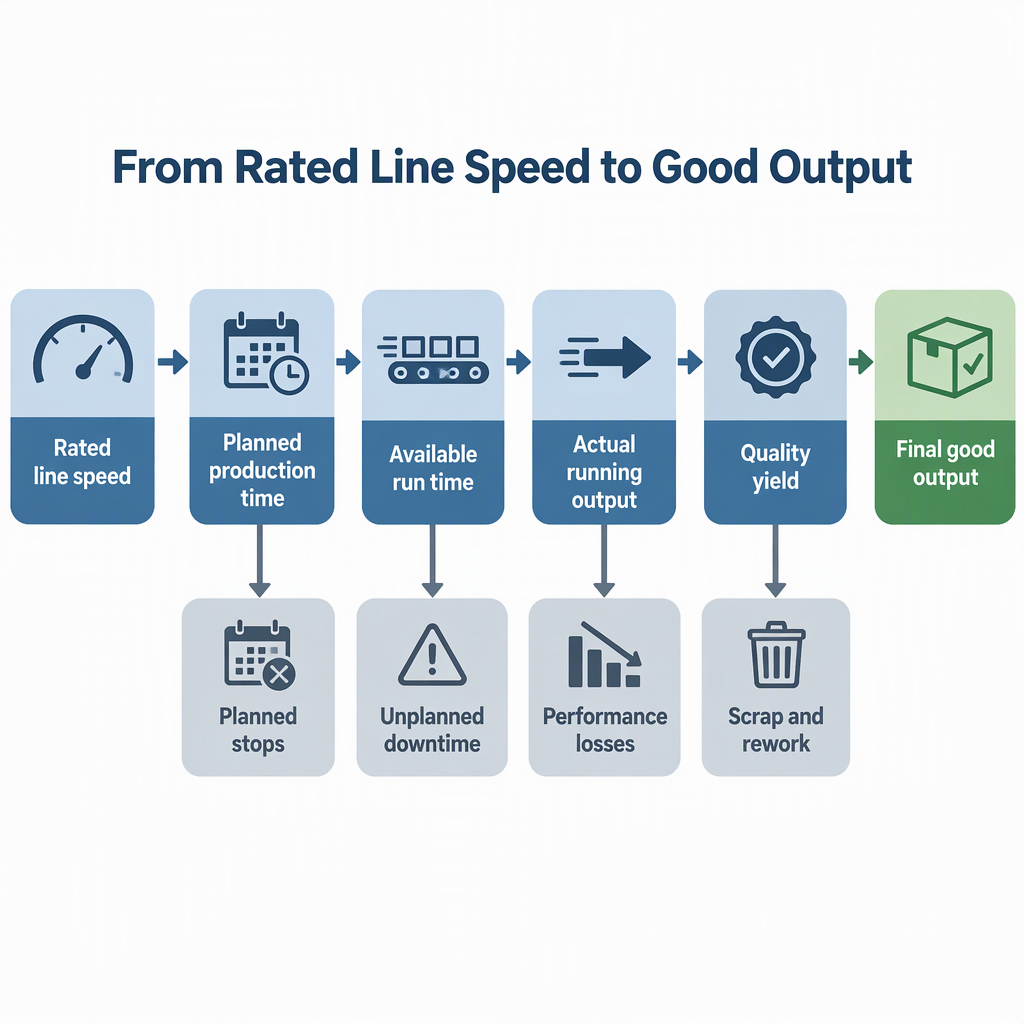
- Start with planned production time. Use the minutes or hours the factory intends to allocate to the job, excluding planned non-production time.
- Estimate availability. Convert planned time into expected run time after setup, changeover, coil handling, job-file checks and ordinary stops.
- Apply performance. Compare the actual or expected run rate with the ideal run rate, or use ideal cycle time to estimate how many members should be produced during run time.
- Apply quality. Reduce total output to good output by excluding rejected, reworked or unusable members.
- Express the result in the buyer’s unit. Use good pieces per shift, good linear meters per shift, or completed job packs, depending on how the factory schedules work.
Manufacturing output models often use Overall Equipment Effectiveness as Availability × Performance × Quality, and an equivalent calculation is Good Count × Ideal Cycle Time divided by Planned Production Time. Buyers can review the formula in the OEE calculation guidance and then adapt the terms to steel framing jobs.
Validate the Estimate With a Representative Sample Run
A sample run is strongest when it uses real job files, representative coil, normal operators, recorded stop time and a defined good-count rule.
- Select representative jobs. Include the profiles, gauges, member lengths, punch patterns, cut counts and labeling requirements that drive the buyer’s normal production mix.
- Prepare the coil and job data. Use coil sizes and software files that match the intended factory workflow rather than a simplified demonstration job.
- Time the complete production window. Record planned production time, start-up checks, run time, stops, changeovers and end-of-job handling.
- Count total and good output separately. Keep the total count distinct from the good count so rejects or rework do not inflate capacity.
- Review downstream effects. Check whether stacking, packing, inspection, material movement or panel assembly becomes the limiting step after the roll forming line runs.
- Use the same acceptance criteria that production will use after purchase.
- Record whether the operator intervened, adjusted the program, restarted the line or removed material during the run.
- Repeat the test if the product mix changes substantially between light-gauge framing, heavier members, roof framing or high-punch-density jobs.
Tie Output Targets to Profiles, Standards and Quality Acceptance
Output targets should be tied to the members the factory must produce: AISI S240-20 applies to design, manufacture, installation and quality of structural members and connections used in cold-formed steel light-frame construction, and the SFIA Technical Guide page describes section properties, limiting heights, load/span tables, fastener notes and typical details for cold-formed steel framing products.
The SFIA Technical Publications page states that its Cold-Formed Steel Framing Products guide is a design resource and says the guide meets requirements of the 2024 IBC, 2022 CBC and 2020 FBC. The AISI design standards listing identifies AISI S240-20 as the North American Standard for Cold-Formed Steel Structural Framing, 2020 Edition, and states that it supersedes the 2015 edition.
Use these references to define the members, tolerances and quality checks for the sample, not to assume that any machine, supplier or produced member is certified. If a project has adopted codes, project specifications or local amendments, confirm the applicable edition and acceptance requirements with the responsible design professional or authority before turning output into a purchasing requirement.
Find the Bottleneck Before You Specify the Machine
A faster roll former improves output only if the rest of the production system can feed, verify, remove and use the good members at the same pace.
| Capacity constraint | What to check before selection | Effect on the estimate |
|---|---|---|
| Coil handling | Loading time, coil changes, coil width changes and material staging | Reduces available run time when changeovers consume planned production time. |
| Punching and cutting | Hole density, notch pattern, cut frequency and short-member sequencing | Changes the practical run rate compared with an ideal speed assumption. |
| Software and job files | Import checks, nesting, labels, revisions and operator confirmation | Can delay start-up or cause rework if data is not production-ready. |
| Quality inspection | Dimensional checks, hole location, cut length, surface condition and traceability | Determines how much total output becomes good count. |
| Downstream handling | Stacking, packing, panel assembly, transport carts and storage space | Can cap usable output even when the forming line has additional speed available. |
Use a Supplier Evaluation Checklist Instead of a Speed Claim
When comparing steel framing machines, ask each supplier to show the assumptions behind the output estimate and to separate ideal speed from good production output.
- Ask which profiles, gauges, member lengths and hole patterns were used for the stated output.
- Ask whether the estimate is based on planned production time, run time, ideal cycle time, total count or good count.
- Ask how coil changes, setup, program changes, inspection and operator interventions are treated.
- Ask for a trial using the buyer’s own job mix when the purchase depends on a specific capacity target.
- Ask how the machine, software workflow and downstream handling will fit the factory’s available space, labor, coil supply and quality process.
- Ask the supplier to identify acceptance criteria for the produced sample rather than relying on a visual demonstration only.
Do not convert a competitor page, brochure speed, or single demonstration run into a universal production guarantee. The useful comparison is the measured good output under the buyer’s product mix and factory constraints.
Keep Unsupported Claims Out of the Estimate
A reliable estimate should define the calculation inputs and acceptance rules; it should not rely on unverified claims about exact hourly output, certifications, delivery time, payback or customer results.
For specification work, separate three items: the machine’s rated or ideal rate, the factory’s expected operating conditions, and the buyer’s good-count requirement. If a supplier states a capacity figure, ask for the job file, material conditions, timing method and quality standard used to produce it.
Use a range when the product mix is still uncertain. A single number is useful only after the factory defines the profiles, coil data, software workflow, inspection method and downstream process that will control the line.
Conclusion
The next step is to build a capacity worksheet around planned time, run time, ideal rate and good count, then test it with representative jobs before specifying a steel framing machine.
For light-gauge steel and roof framing manufacturers, the best capacity estimate is not a copied line-speed number. It is a controlled production assumption that connects the required members, coil and job data, forming quality, factory handling and buyer acceptance criteria.
FAQs About Steel Framing Machine Production Capacity
These questions help buyers apply the method without turning rated speed into an unsupported production promise.
Is rated line speed useful at all?
Yes. Rated speed is useful as the ideal-rate input, but the estimate still needs availability, performance and quality before it becomes expected good output.
Should output be stated in pieces or linear meters?
Use the unit that matches scheduling and delivery. Long repetitive members may be easier to plan in linear meters, while cut-to-length job packs are often clearer in good pieces per shift.
Why separate total count from good count?
Total count can include rejected or reworked members, while good count reflects output that meets the defined acceptance checks and can be used for the job.
What should be included in a sample run?
Include representative profiles, coil conditions, member lengths, hole patterns, cut counts, job-file workflow, operator actions, stop time, quality checks and downstream handling.
Do standards change the capacity calculation?
Standards such as AISI S240-20 relate to cold-formed steel structural framing design, manufacture, installation and quality. They affect capacity work by helping define what a good member must satisfy, not by proving a specific machine’s output.
What is the most common mistake in capacity selection?
The common mistake is treating ideal speed as good output while ignoring planned stops, performance losses, rejects, rework and downstream constraints.
How can two suppliers be compared fairly?
Give both suppliers the same job mix, timing rules and good-count definition, then compare the resulting estimate or sample run rather than comparing headline speed alone.


